

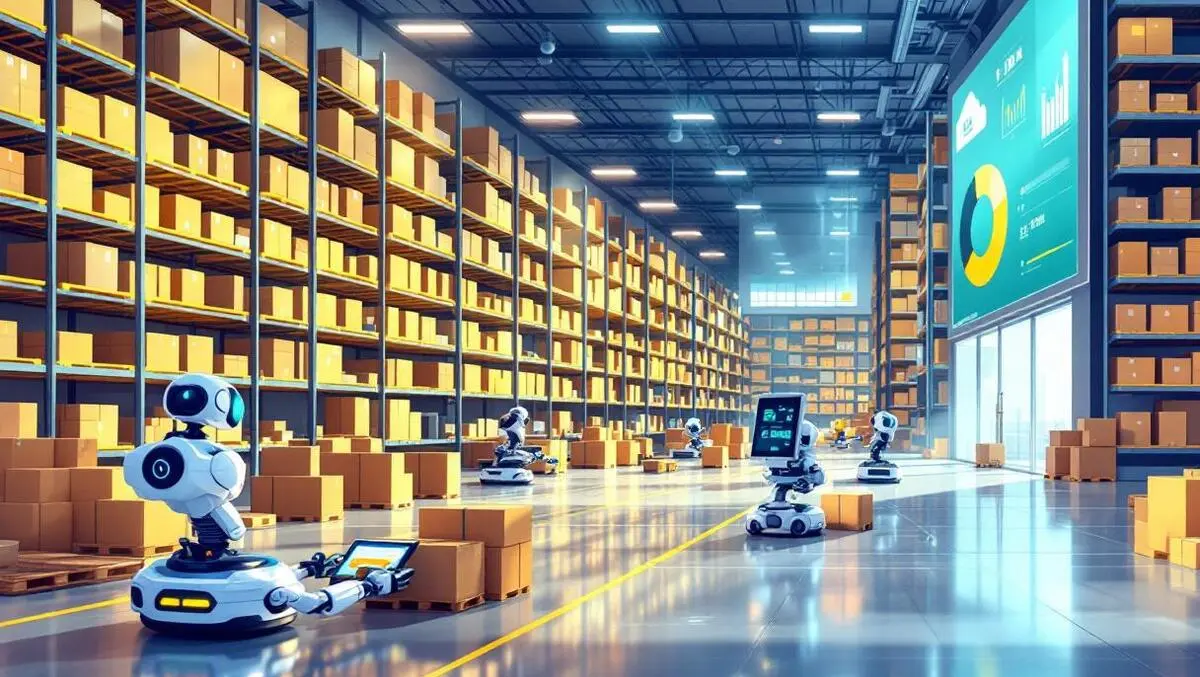
AI drives productivity & resilience in global warehouse sector
Thu, 27th Nov 2025
Artificial intelligence and automation are now at the heart of global warehouse operations, with 60% of facilities worldwide reporting embedded AI in daily workflows. This is driving new levels of productivity, workforce evolution and rapid returns on technology investments, according to research by Mecalux and the MIT Intelligent Logistics Systems Lab.
Widespread adoption
The findings are based on a survey of over 2,000 supply chain and warehousing professionals across 21 countries. Over 90% of respondents indicated their warehouses employ AI or advanced automation in some form. More than half of surveyed organisations operate at advanced or fully automated maturity levels, particularly among large businesses.
Uses of AI have moved beyond pilots to underpin tasks such as order picking, inventory optimisation, equipment upkeep, labour planning and safety checks. The report highlights that AI supports not just increased volume and accuracy but also adaptability in coping with supply chain volatility.
"The data show that intelligent warehouses outperform not only in volume and accuracy, but in adaptability. As peak season approaches, companies that have invested in AI aren't just faster - they're more resilient, more predictable and better positioned to navigate volatility," said Javier Carrillo, CEO, Mecalux.
Fast payback
Most businesses now allocate 11% to 30% of their warehouse technology budgets to AI and machine learning. The typical payback period for these investments is reported as two to three years. Enterprises cite clear gains in inventory accuracy, throughput, labour efficiency and fewer errors as sources of these returns.
The research points to a shift from exploratory AI spending to a focus on long-term capability. Drivers for investment include the need to cut costs, meet customer expectations, address labour shortages, sustainability targets and fend off competition.
Integration challenges
The move towards intelligent warehouses is not without difficulties. Technical expertise, integrating systems, ensuring data quality, and controlling costs were highlighted as ongoing barriers. Linking advanced AI tools with legacy equipment and software remains a considerable challenge even for established firms.
"The hard part now is the last mile: integrating people, data and analytics seamlessly into existing systems," said Dr. Matthias Winkenbach, Director of the MIT ILS Lab.
Despite these obstacles, companies report progress in data management and project delivery. Many are focusing on clearer roadmaps, increased budgets, better tools and internal upskilling to accelerate further AI take-up.
Workforce impact
The report disputes fears of widespread job losses from automation. Over three-quarters of surveyed organisations have observed increased productivity and employee satisfaction since introducing AI, with more than half growing their workforce. New roles in AI and machine learning engineering, automation, process improvement and data science are emerging across the sector.
AI is seen as expanding opportunities for human workers, rather than simply automating their roles.
Future trends
Looking ahead, almost all respondents plan to increase AI adoption in the next two to three years. Eighty-seven percent say their AI budgets will rise, and 92% are piloting or planning new AI projects. Generative AI stands out as the most valued approach, supporting applications from automated documentation and warehouse layout to process design and automation scripting.
"Traditional machine learning is great at predicting problems, but generative AI actually helps you engineer the solution. That's why companies see it as the biggest value generator in the warehouse today. Ultimately, the measurable gains from automation are productivity wins, making existing systems work smoother, faster and with fewer disruptions," said Winkenbach.