From 3am deployments to AI-native HR: building intelligent, human-centred systems
Wed, 17th Dec 2025
I remember the days of 3am deployments and scrambling to fix issues after they blew up. Now, with AI and automation, we can spot the 'needle in the haystack' early and solve in minutes what once took weeks, preventing outages and reducing the need for overtime fire-fighting.
Over the years, I've seen how technology transformations unfold across industries, from healthcare and fintech to telco, media, and now HR tech. There's a familiar pattern; first, manual systems must evolve to digital, then automation follows, and before long, intelligence becomes embedded. Just as DevOps - the fusion of development and operations - evolved into MLOps (machine learning operations), HR technology is now evolving into something new: AI-native systems.
An AI-forward mindset
Everyone talks about being "AI-first," but at ELMO Software we prefer to think of it as AI-forward. It's not about chasing every new model or tool. It's about applying AI in ways that genuinely help the customer, elevating every role, across every function.
At ELMO, we're taking a two-pronged approach. The first is the product itself: making our HR platform more predictive, efficient and personalised. The second is the ecosystem, which is where my team and I come in. Our focus is on embedding AI into every touchpoint, so the platform becomes AI-native, not AI-adjacent. My team focuses on this layer, ensuring intelligence is built into the fabric of our systems, rather than added as an afterthought.
Three layers of an AI-native HR platform
We think about AI in HR across three interconnected layers.
- Embedding AI into core processes - automating workflows across sales, HR, and customer success to reduce friction and improve productivity.
- Creating intelligent feedback loops - using every interaction to improve predictions and insights, so we can personalise the employee experience at scale.
- Building contextual decision support systems - surfacing insights at the moment of need, acting like a sounding board for both employees and managers.
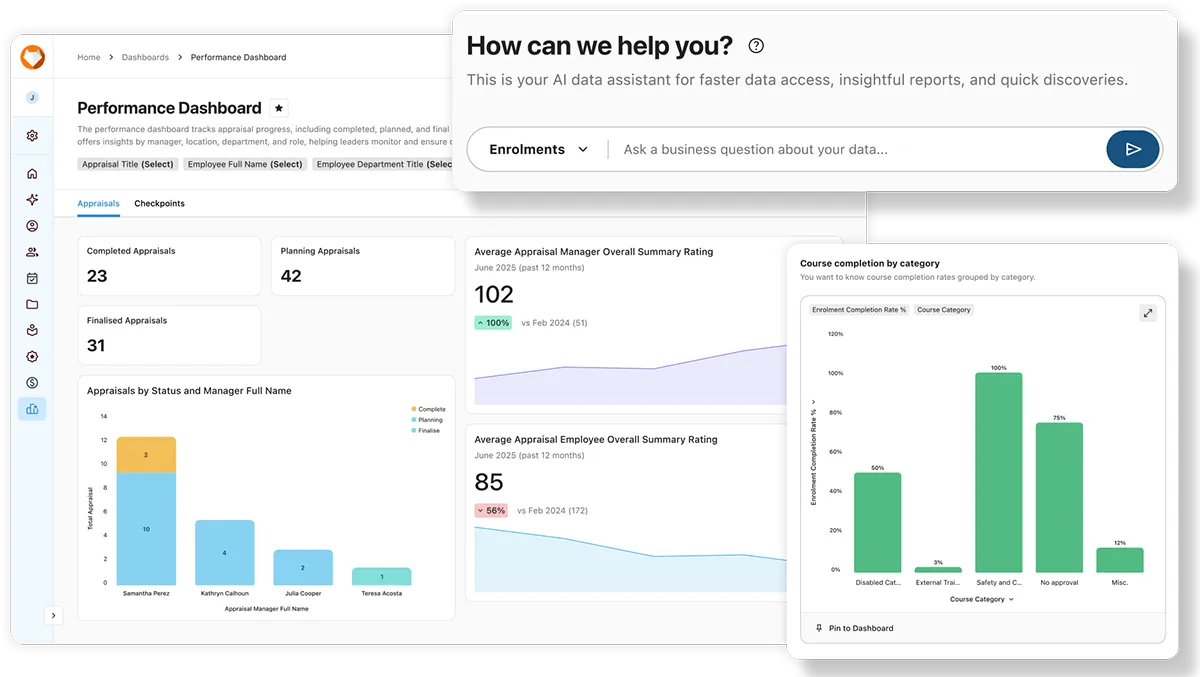
This shift takes us from reactive to predictive operations. For example, using predictive analytics, we're building traffic-light dashboards that flag customer churn risk early, allowing our teams to intervene sooner. Predictive analytics is where I see the biggest opportunity; when powered by strong data foundations, it enables leaders to anticipate rather than react.
These capabilities extend into workforce planning and compliance, automating what used to be time-intensive tasks in real time. AI can correlate data from A, B, and C to give insights faster, adding more value in customer relationships. The ability to anticipate the employee lifecycle using predictive analytics, rather than simply react to it, is incredibly exciting, because it takes us to a true place of strategic enablement.
Human-centred AI and ethical guardrails
For AI to truly serve people, it must be built responsibly. At ELMO, we're guided by privacy-by-design and human-centred principles that emphasise transparency and accountability.
We've established a cross-functional AI governance team that meets fortnightly to ensure our policies remain fit for purpose. This group brings together voices from engineering, legal, customer success, security and HR, representing every facet of the business.
Over-automation is actively guarded against. We always keep a human in the loop because critical thinking and problem solving are things we don't intend AI to replace. AI makes recommendations, not decisions. That philosophy guides how we test for bias, prevent hallucinations, and ensure accuracy doesn't degrade over time.
Augmentation, not automation
There's often a fear factor around AI. People worry it will replace their roles. When we moved from System Engineering to DevOps, the same concern existed. In reality, it created more meaningful work and greater career development for those who embraced the change. In my own case, it opened a pathway from DevOps manager to data analytics, and now to ML Ops.
The key is investing in change management from day one. Technology itself is rarely the hardest part; what requires the most care and intention is helping people adapt to new ways of working.
In my team, we started by landing some quick wins, like building AI-assisted workflows or automating repetitive, low-value tasks. We always define clear success metrics and work to show ROI within the first 90 days. Those early results build trust and momentum, demonstrating that AI isn't about replacing people; it's about augmenting human capability.
Building a human-centred ecosystem
AI isn't just about efficiency gains; it's fundamentally about creating stronger business outcomes. HR leaders today need insights that span the full employee lifecycle, not siloed processes. At ELMO, we're not simply trying to implement AI - we're pioneering a new category of intelligent HR systems that help organisations anticipate, not just respond.
Our goal is to build a sustainable ecosystem that creates opportunities for every individual and amplifies human development. It's about balancing proprietary builds with pre-trained models, and empowering every team with the tools to experiment safely and responsibly.
When everyone across an organisation has the tools, mindset and confidence to explore AI, it stops being a technology project and becomes a cultural shift. The first step may feel uncertain, but an AI-forward mindset is what turns curiosity into capability – and capability into competitive advantage.