

Teqare expands cyber safety for First Nations wealth
Thu, 6th Aug 2026 (Today)
Teqare has expanded its cyber safety and financial literacy education for First Nations communities in Canada. Founder Darion Ducharme says the work now reaches more than 80 First Nations, schools and elder communities.
The effort focuses on protecting communities as treaty settlement payments and other sources of personal and community wealth attract online fraud. Ducharme, Founder of Teqare and a member of Lac Seul First Nation, said the issue became personal after a local Chief's mother lost CAD $90,000 to an online scam.
Ducharme founded the organisation after a decade in telecommunications at Bell, Rogers and Telus. He said his early focus on cybersecurity training broadened when he realised technical advice alone did not address the financial risks facing people who were new to managing larger sums of money online.
Teqare now uses a four-part model that combines AI scam prevention, cybersecurity training, cyberbullying protection, financial literacy and what it describes as digital sovereignty. The financial literacy component covers budgeting, saving and banking. The cyber training is designed to help people identify warning signs, protect personal data and avoid online fraud.
The issue has drawn attention as some First Nations communities receive large treaty settlements. In Manitoba, "cows and plows" agreements have included individual payments of as much as CAD $100,000, according to information released by the organisation.
Ducharme argues that settlement money and other forms of new wealth can quickly become targets for increasingly sophisticated scams, especially as fraud tactics use more automated and convincing digital tools. He has presented financial literacy as a key line of defence alongside cybersecurity training.
Growing risk
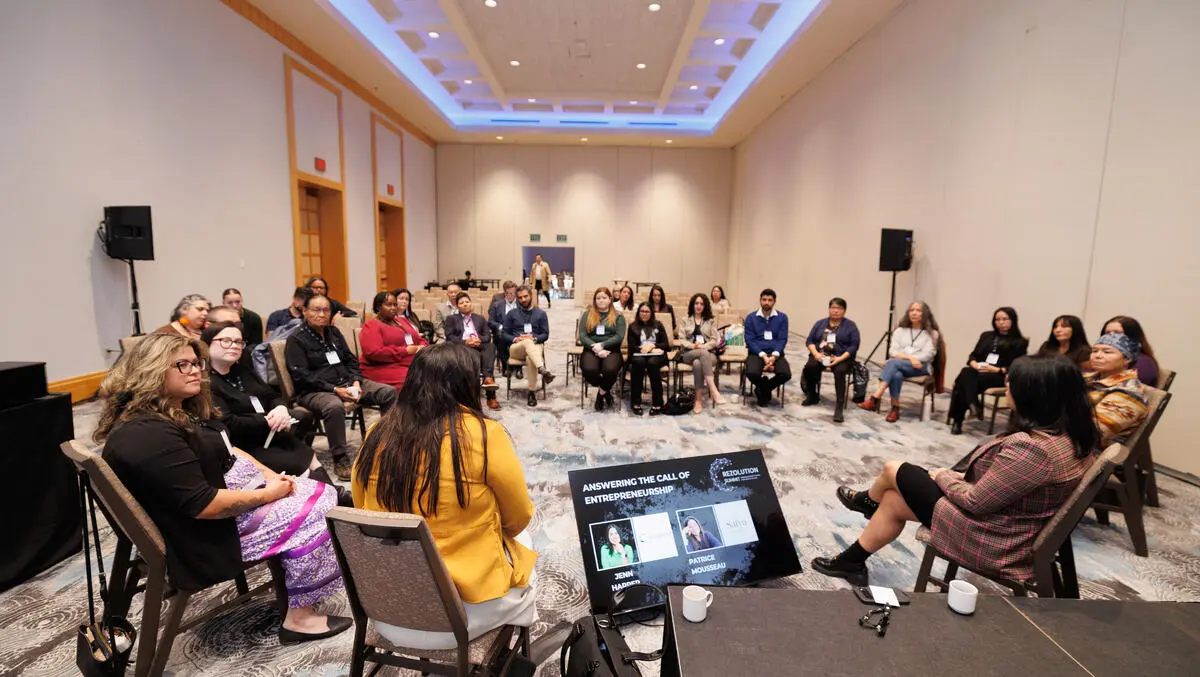
Across Indigenous communities, a wider push is under way to strengthen economic self-determination while expanding access to capital, education and technology. That discussion has also shaped the agenda of Rezolution Summit, an Indigenous-led wealth creation platform in Canada focused on practical approaches to long-term prosperity.
Organisers say Indigenous entrepreneurs contribute about CAD $48.9 billion a year to Canada's economy, citing figures from the National Indigenous Economic Development Board. They add that many still face barriers to capital, financial education and long-term wealth building.
Michele Young-Crook, Co-Founder of Rezolution Summit, linked wealth creation to a broader political and social agenda. "Indigenous wealth creation is about far more than just economics. It's about sovereignty, self-determination, and building prosperity that protects our families and Nations," Young-Crook said.
She said the event was designed to deliver practical outcomes for participants. "We intentionally designed this summit to bring together speakers, sponsors, and partners who are committed to sharing real, practical strategies. Every attendee should leave with tools they can apply immediately to strengthen their finances, both personally and within their communities," Young-Crook said.
Practical focus
Janice Gladue, Co-Founder of Rezolution Summit and a member of Sweetgrass First Nation, said the aim is to create a forum led by Indigenous participants rather than outside institutions. "As an Indigenous-owned and operated summit, Rezolution is a space where solutions are built and relationships are strengthened through transparency and mutual accountability," Gladue said.
She said the work has implications beyond individual businesses and communities. "We are proud to help build an ecosystem where Indigenous economic leadership is driving lasting change across Canada. When we create wealth that reflects our core values, we help transform the country's collective economic future," Gladue said.
The summit's programme has expanded to include governance, institutional capital, founder succession and wealth preservation. Other sessions cover personal finance, life insurance, corporate risk management, investment readiness, trusts, estate planning and procurement opportunities.
For Teqare, that broader discussion overlaps with day-to-day digital safety. Its work on cyberbullying and online harms reflects the view that financial security, personal safety and digital participation are increasingly connected in remote and rural communities.
Ducharme has compared the current rush around artificial intelligence with the late-1990s dot-com bubble, arguing that Indigenous communities should not be excluded from technologies shaping economic life. He maintains that ownership, education and protection must develop together if communities are to avoid becoming targets while others capture the value.
That argument places Teqare's work at the intersection of digital inclusion and consumer protection. As more services, communications and financial transactions move online, risks for communities with uneven access to training and support may rise alongside the opportunities.
Teqare's message to Indigenous leadership is that scam prevention, cybersecurity and financial life skills must be treated as part of the same challenge if incoming settlement wealth is to be protected from fraud.